
How to design a winning MVP for your startup




Subscribe to receive Elixir news to your inbox every two weeks.

Expand your skills
Download free e-books, watch expert tech talks, and explore open-source projects. Everything you need to grow as a developer - completely free.
This guide will help you zero in on the right mindset and priorities for designing an MVP that actually does its job – engaging users and proving your concept.
It’s 2 AM and you’re staring at a massive to-do list for your product. Between investor meetings, user requests, and a looming launch date, you feel completely overwhelmed trying to design your startup’s first MVP. You’re moving fast (because you have to), yet progress never feels like enough. Sound familiar?
“Minimum Viable Product (MVP)” – you’ve heard the phrase a hundred times. Everyone says just build an MVP… but no one agrees on what that actually means when you’re in the thick of it. Should your MVP be a polished app or a scrappy prototype held together with duct tape? How many features is “minimum”? What does “viable” include? It’s easy to second-guess every decision.
Don’t worry. We’re going to cut through the noise and focus on what really matters.
MVP mindset: think of it as an experiment
Let's start with the first popular misconception and say it loudly: MVP isn’t a smaller version of your big, shiny product vision – it’s a tool for learning. Think of it as an experiment. You’re trying to test your core idea with the least effort and time possible, not build a perfect product out of the gate. In startup product design, the MVP stage is about validating assumptions and gathering feedback, not chasing perfection.
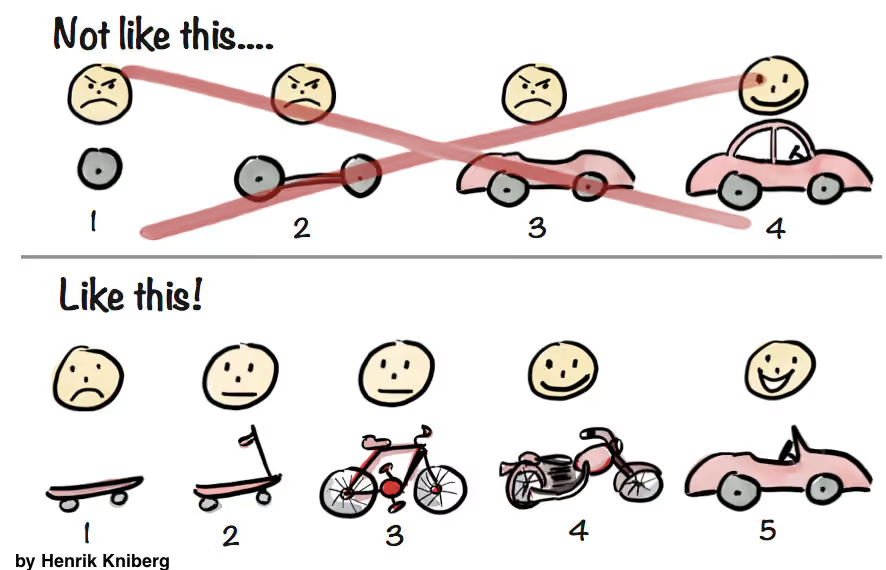
This perspective can be a relief. It means you can give yourself permission to be imperfect. Your first version will be rough around the edges – and that’s expected. (If you’re completely proud of your MVP, you probably waited too long to launch it.) The goal is to get a working solution in front of real users quickly, so you can see if you’re on the right track. Every day spent polishing beyond “viable” is a day you’re not collecting feedback.
What’s the quickest way to test if this idea actually solves a real problem?
In practice, adopting an MVP mindset feels like a weight off your shoulders. You stop thinking, “How do I build the product right now?” and instead ask, “What’s the quickest way to test if this idea actually solves a real problem?” It’s more science lab than Shark Tank. By treating your MVP as a temporary experiment, you free yourself from the pressure to have all the answers on day one.
Decide what matters (and ignore the rest)
One of the hardest steps is deciding which features to include in your MVP and which ones to postpone. When you’re staring at a long list of ideas, everything feels important (and hey, one day it might be). But right now, you need to be ruthless.
What should your MVP include?
Focus on the single core problem you’re trying to solve. And here we could end, but let's go through the topic thoroughly.
Your MVP should concentrate on the few features that directly solve that problem, the things that deliver the primary value to your users. Ask yourself for every feature:
Is this absolutely required to provide the minimum value to the end user?
If the answer is no, cut it (for now). Be clear on the key assumption or hypothesis you’re testing. If a feature isn’t critical to that validation, it doesn’t belong in the MVP.
Make sure the features you do include create a complete, end-to-end experience for the core use case. An MVP still needs to feel usable. For example, the team behind Twitter knew their MVP had to let users post tweets and follow others – without both, the product wouldn’t make sense. But they didn’t need features like saving or favoriting tweets in the first version. Similarly, if you’re building a ride-sharing app, you absolutely need a way for riders to request a ride and drivers to respond. You don’t need a fancy profile system or an advanced rating algorithm on day one.
In short, include only the “must-haves” – the features that define your product’s value and that you can’t test your idea without. Everything else can wait a few versions.
What should you leave out of your MVP?
Now for the flip side: what not to include. You can confidently ignore a bunch of things that would be overkill on day one:
- Nice-to-have features: Anything that isn’t central to your product’s main purpose can go. That cool referral system or multi-step onboarding tutorial? Save them for later.
- Polish and perfection: Don’t spend weeks making the UI pixel-perfect or fine-tuning every line of code. As long as it’s functional and clear, minor ugliness or inefficiencies are fine at this stage.
- Scaling and performance: Design for dozens of users, not millions. You don’t need a complex, “enterprise-grade” architecture for an MVP. If your product magically blows up overnight, that’s a good problem to tackle then.
- Automation and “smart” systems: If a process can be done manually or with a simple script in the early days, do that instead of building a whole automated system. (Many great startups began with clunky behind-the-scenes manual work.)
In short, don’t over-engineer anything. An MVP is the time for scrappy solutions and shortcuts, not elegant, long-term frameworks. You’re aiming to learn quickly, not win awards for the most well-engineered app of the year.
Nick Swinmurn, founder of Zappos, didn’t build a giant online store as his MVP. Instead, he took photos of shoes at local shops and posted them on a simple website. When a customer placed an order, Nick would go buy that pair from the store and mail it to them – he actually lost money on those early sales, but he learned what he needed. This scrappy test validated the core question (“Will people buy shoes online?”) without investing a dime in inventory or automation.
UI and UX: basic but usable
How polished should your MVP UI be?
Your MVP’s design should be as simple as possible while still being usable. In other words, function over form. Users will forgive a basic or even clunky interface if it solves their problem. What they won’t forgive is a product that’s confusing or broken.
Ensure that the core flows work and users can actually find their way around your MVP without frustration. The main user journey (the “happy path”) should be smooth enough that people can complete the primary task. You don’t need fancy graphics or a trendy design – a clean, simple layout is perfect. If your app’s purpose is visually driven or aimed at designers, you might invest a bit more in UI polish. Otherwise, as long as folks can use it and understand it, you’re golden. Remember, you can always improve the aesthetics later, once you’ve validated that your product is something people want.
Launch early and learn from users
The whole point of an MVP is to get real-world feedback. That means you have to actually put it in front of real users. Don’t spend 6 extra months tinkering in stealth mode – find a handful of friendly early adopters (or beta users) and let them try your MVP as soon as it’s usable.
You might feel nervous (remember that “embarrassed” feeling?), but showing your product to actual users will teach you more in a week than internal planning could in a year.
When users get their hands on your MVP, pay close attention. Watch how they use it, where they get confused, what they love, and what they ask for next. Maybe you’ll discover that one feature you thought was minor is actually critical to them, while a “must-have” on your list barely gets noticed. This kind of insight is gold. Use it to iterate – quickly. Tweak the UI if people are stumbling. Add a tiny tutorial if folks keep asking how to do something. Perhaps you’ll even pivot your focus entirely if feedback shows your product is solving a different problem than you imagined.
The key is to treat your MVP as a learning process. You’re not aiming for huge sales or scale yet; you’re aiming to validate (or invalidate) your idea and make it better. So launch early, listen hard, and be ready to adjust. Early users tend to be forgiving if you’re upfront that this is a “beta” product – many actually enjoy being part of the creation process. Involve them. A “winning” MVP isn’t one that racks up a million dollars overnight; it’s one that gives you the information and confidence to take the next step, whether that’s polishing the product, adding features, or even rethinking your approach entirely.
MVP checklist: do’s and don’ts
Do
- Focus on one core problem. Identify the primary user need you’re addressing and design your MVP around solving that problem (nothing more).
- Build a simple, usable solution. Ensure your MVP delivers a complete basic experience for that one use-case, even if it’s bare-bones.
- Launch quickly. Get the MVP into users’ hands as soon as it’s functional. Real feedback early on is far more valuable than weeks of extra development.
- Listen and learn. Observe how users interact with your MVP and gather their feedback. Use those insights to iterate and improve rapidly.
- Stay flexible and open-minded. Treat the MVP as an experiment. Be ready to adjust your ideas based on what you learn (that’s the whole point!).
Don’t
- Cram in every feature. Resist the urge to include “nice-to-haves” or secondary features in your MVP – you risk diluting the core value.
- Polish endlessly. Don’t waste time making things perfect or pretty. A bit of roughness is fine if it means you launch sooner.
- Over-engineer the tech. Avoid complex architectures or premature scaling. Build just enough to work for now; you can refactor when you have proven demand.
- Wait forever to release. Don’t hold back your MVP out of fear or pride. You’ll learn more from a half-finished product in the wild than a fully finished product in your head.
- Ignore the feedback. Don’t dismiss what users tell you (through their words or behavior). Be willing to change course if your assumptions turn out wrong.
Great design makes great products. Let’s make yours stand out.
Related posts
Dive deeper into this topic with these related posts
You might also like
Discover more content from this category

Even the best-designed products can fail if users get stuck, confused, or frustrated. That’s where a UX audit template comes in – a structured way to uncover usability issues that might be costing you customers and revenue. This template is part of a set of templates designed to streamline the audit process.

Launched your MVP? Learn how to prioritize fixes, embrace user feedback, and skip over-polishing. Essential post-launch tips for startup founders,

Build a clean, clear, credible pitch deck for early-stage investors. Focus on what matters, skip the fluff, and design slides that win trust and spark interest.